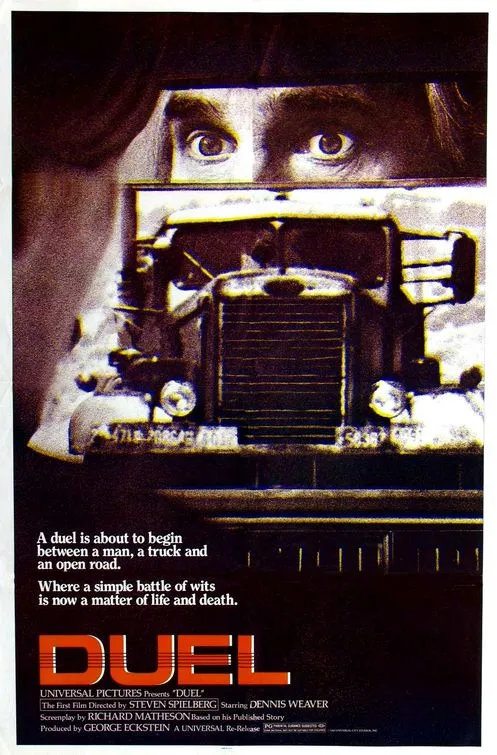
Duel
The From Below Microcinema presents Part 3 of Gender, Sex, and Cars:
*Duel (1971) *on Wednesday, 2/28, at 7:00pm.
Here is the link to reserve a seat. Doors will be at 6:50 and we’re starting the movie at 7:10!
Before there was E.T., or Jaws, or Indiana Jones; before Spielberg was Spielberg, there was Duel. Steven Spielberg made his 1971 directorial debut at just 25 with Duel, a sparse, made-for-TV thriller starring Dennis Weaver as the aptly named David Mann. A father, husband, salaryman, and driver of a little red sports car, David Mann is tormented by the filthiest big rig in the world on a southern California highway. A kind of parable, sparse and minimalist, with no backing score and shot against a bright, dusty desert backdrop, the film features more honking than actual dialogue. Like Mann in the film, we the audience are invited to project our own fears on the rusted canvas of a filthy, mechanized instantiation of dread and anxiety, of some looming, rumbling inevitability, pressing on just over our shoulders. Where many thrillers derive their affective force from the ominous powers of the dark and night, Duel, set entirely during the day on the expanse of the open road, crafts a magnificent confrontation with the opacity of an uninterpretable Thing unexpectedly bursting into a realm as routine and mundane as a long drive. Is Duel about a crisis of masculinity? Is it a class struggle? Does it show the limits of language itself? The return of the repressed? Abjection? Pollution? Come watch for 90 perfect cinematic minutes as David Mann’s sense of self and gender is absolutely undone by the shadow and roar of a long-haul truck.
We leave you with a story from Kafka:
He has two antagonists: the first presses him from behind, from the origin. The second blocks the road ahead. He gives battle to both. To be sure, the first supports him in his fight with the second, for he wants to push him forward, and in the same way the second supports him in his fight with the first, since he drives him back. But it is only theoretically so. For it is not only the two antagonists who are there, but he himself as well, and who really knows his intentions? His dream, though, is that some time in an unguarded moment – and this would require a night darker than any night has ever been yet – he will jump out of the fighting line and be promoted, on account of his experience in fighting, to the position of umpire over his antagonists in their fight with each other.