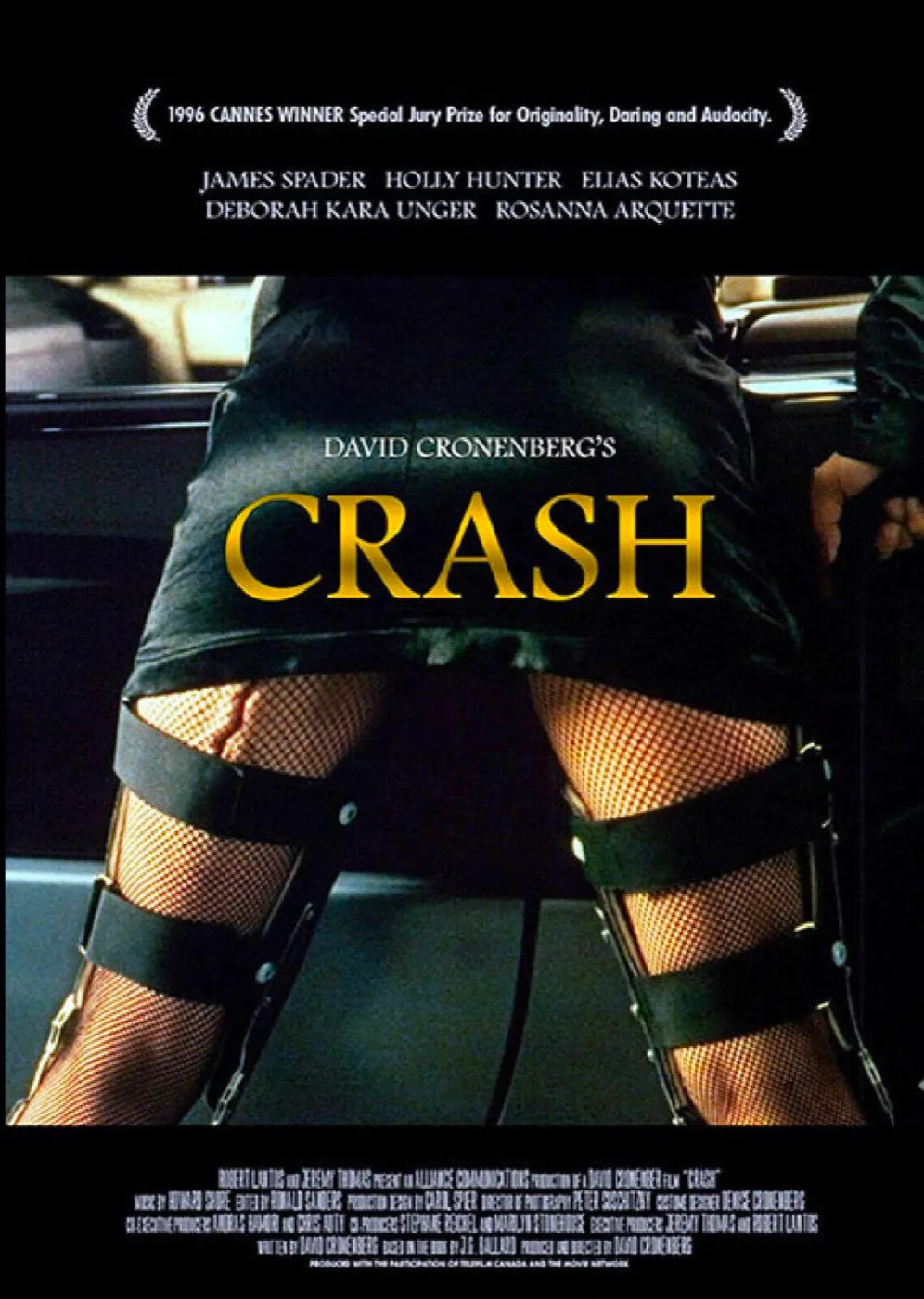
Crash
The From Below will be screening David Cronenberg’s Crash (1996) on Thursday, 3/7,
at 7 pm. This will be our fourth and final installment of the Gender, Sex, and Cars series.
Here is the link to RSVP. Doors will be at 6:50 and we’re starting the movie at 7:10!
Described (negatively) as a “crazed, morbid roundelay of dismemberment and sexual perversion” by the New York Times on its release, and met with boos, taunts, and efforts to censor at its premiere, David Cronenberg’s Crash (1996) is a profoundly polarizing film. James Spader stars in this adaptation of the JG Ballard novel of the same name as a film producer who becomes initiated into a small sex death cult that eroticizes car crashes. After the first one hundred years of growing entanglement between human life and car technology comes to a close, a new flesh is emerging at the turn of the millennium for the characters of Crash, one that offers new sensual horizons, new kinds of sex organs and orifices, new kinds of libidinal economies, where sex and death, pleasure and pain, flesh and metal collide and fold into one another.
Early outraged viewers of the film challenged Cronenberg, declaring, “A series of sex scenes is not a plot,” to which he shrugged, blankly, “Well, why not? Why can’t it be?” What happens to sex and the body in late capitalism, he asks us, amid the asphalted tangle of parking lots, on-ramps, and freeways that compose our urban centers, built more for the circulation of cars and financial data than people? Gone are the flashy red cars or sexy flame decals, and even the rust and bug guts we saw in Christine (1983), Titane (2021), and Duel (1971), replaced by the sleek, passionless, interchangeably repeating chromes, grays, blacks, and whites of Cronenberg’s automotive world. Crash is an experiment in structure and style that may or may not hold. It sits precisely at a major turning point in Cronenberg’s career, the link between his genre-defining body horror action films of the 70s-early 90s, with their rubbery prosthetics and practical effects, to his more austere psychological thrillers to come in the oughts and 2010s.
Rumor has it that there might even be a *Crash *zine available to attendees?