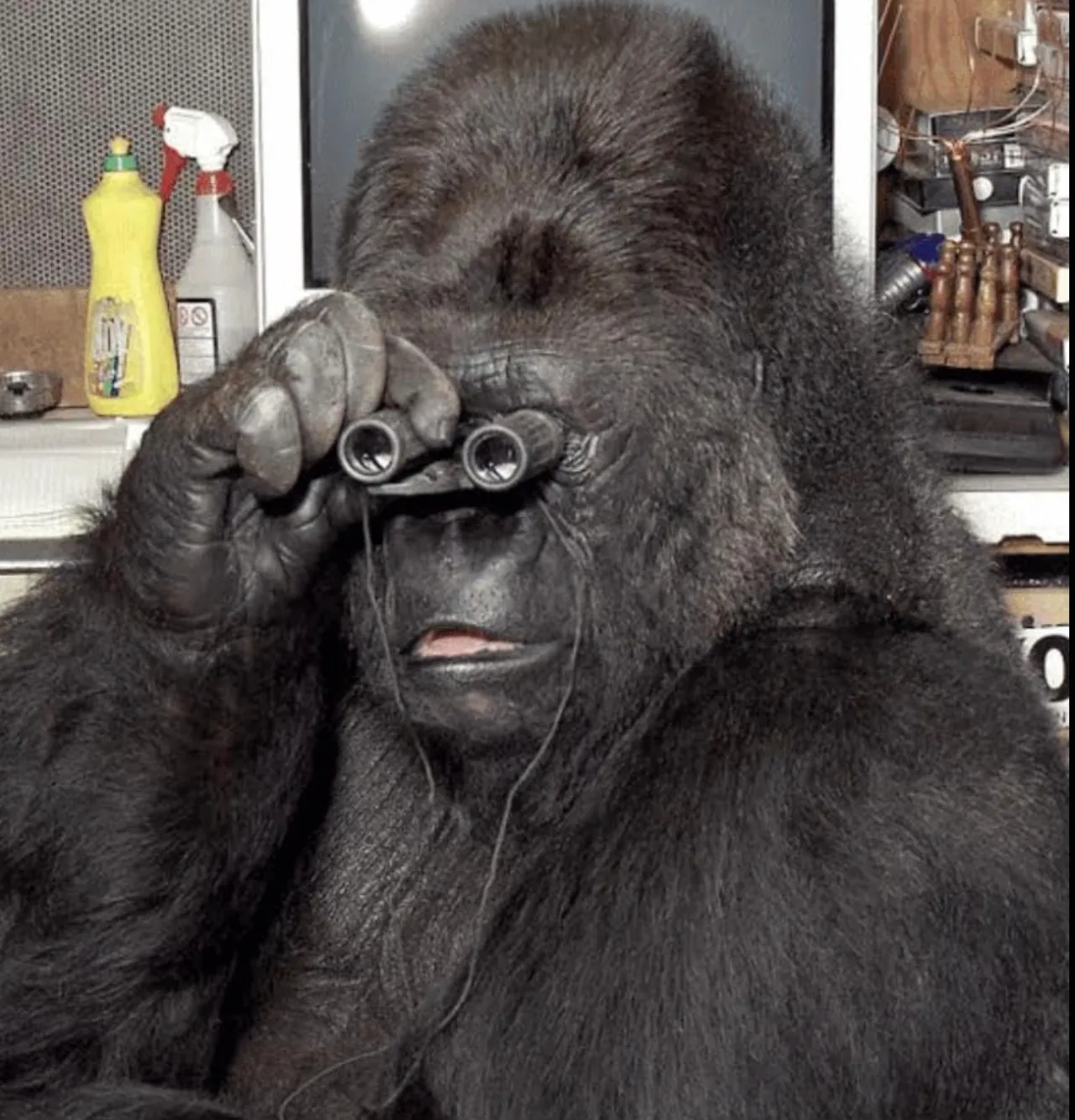
Koko: A Talking Gorilla
This week we are showing Barbet Schroeder’s documentary Koko: A Talking Gorilla (1978) on Saturday 4/18, at 8pm. Note that we are switching back to our 8 PM start time now that the days are getting longer!
Here is the link to RSVP. Doors are at 7:50 and we’re starting the movie at 8:10.
I had a curatorial debate between two documentaries to put into this slot for Ape-ril: Schroeder’s portrait of a young star on the rise—arguably the most famous simian (non-human division) on the planet—and Frederick Wiseman’s Primate, a prototypically bleak and bleakly hilarious look at the Yerkes Primate Research Center. These two documentaries are profoundly divergent from each other in how they depict humankind’s relationality to our apely cousins. Koko: A Talking Gorilla introduces us to the team surrounding Koko, ‘educating’ her by ‘teaching’ her GSL (a modified form of ASL, I’ll give you one guess what the G stands for) and caring for her in captivity. Chief among those is Dr. Penny Patterson, the spearhead for the Koko experiment, a person who builds a bond so strong with Koko that it veers into complicated forms of codependence and parasociality. Koko as a phenomenon, captured in its nascent form in this documentary, is ultimately about trying, failing, and trying harder to see and treat a gorilla as a human. Primate, on the other hand, is about a community of scientists doing what they can to separate themselves from the interspecies relationality that they might have with their subjects. In order to do their work, the hideous work of scientific experimentation and dissection, they need to see the apes and monkeys as material rather than brethren. While Primate is a brilliant film and completely worth watching, it’s also a viscerally unpleasant experience.
So, Koko: certainly not an unpleasant experience, as we get to spend time with the Talking Gorilla as she cavorts, signs, and interacts with other simians. And yet, there’s something amiss outside of the frame of the movie. Nearly 50 years since the documentary was made, and almost a decade since the passing of the beloved ape, we now have a different understanding of the ‘science’ that led Koko to becoming a phenomenon—it’s mostly been debunked, reliant on (one could say) imperfect understandings of ASL as it relates to spoken language, and the idea that Koko possessed the faculties for language are now seen as overstated. In that way, the documentary shifts to being a fascinating portrait of the relationship between Penny and Koko, whom she asserts throughout as ‘just as good as’ or ‘better than’ a three year old child. One begins to wonder just what drives a person to make the elision to try and see their animal kin as human. In that way, both documentaries capture a striving towards a fraught polarity: seeing animals as too human to be animal or seeing them as too inhuman to be creature. In either case, the centralization of ‘human’ feels like a downfall and a closing of the possibilities of life. And yet, Koko remains, a wonderful ape, a creature we are lucky to have lived alongside.
Signing off,
Charlie, Stefan, Stark