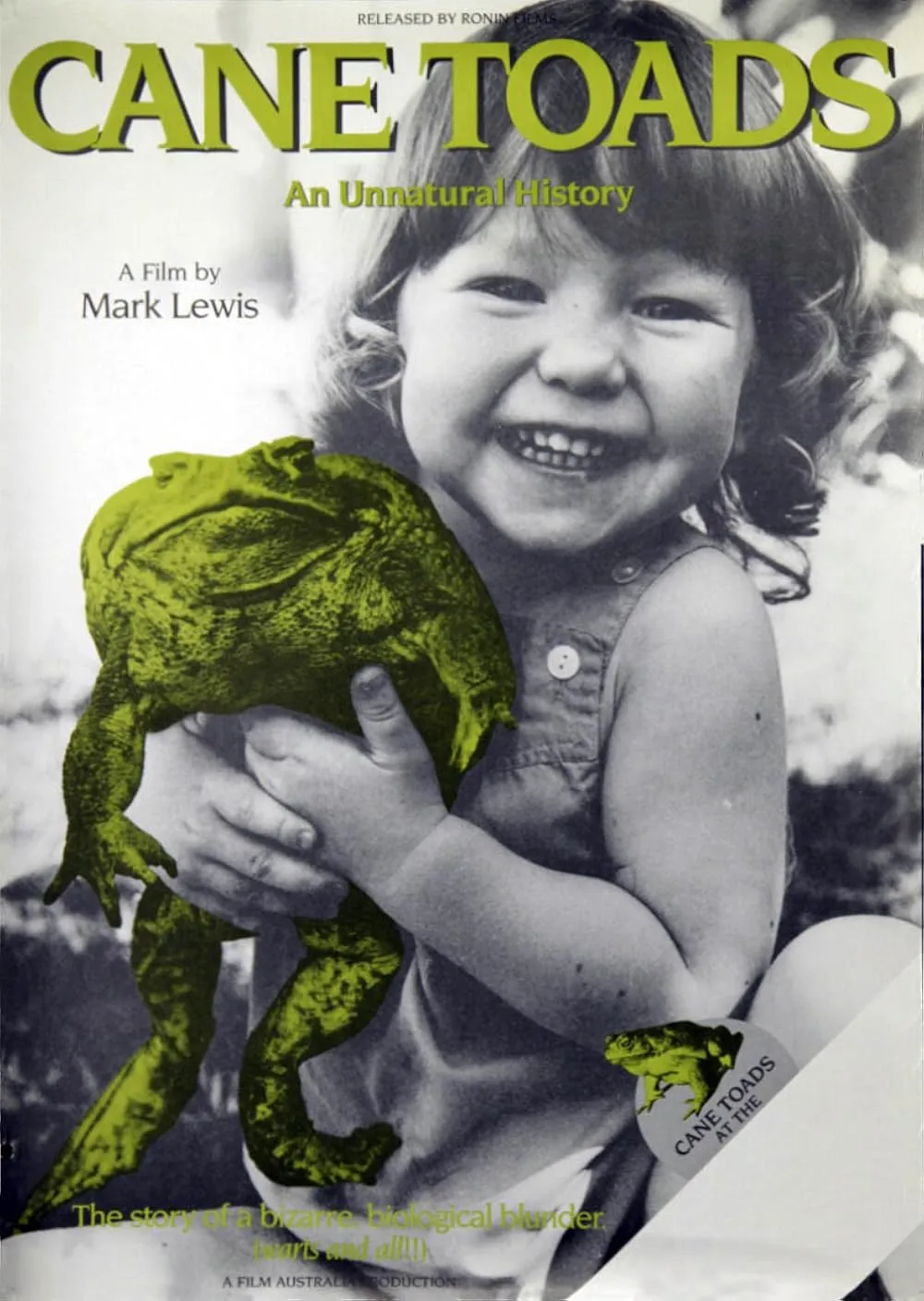
Cane Toads
A documentary short and classic in environmental history, Cane Toads focuses on the scientific, environmental, aesthetic, economic, medical, and symbolic entanglements lived out in the 1980s between (white) Australians and Bufo marinus, the “cane toad.” After experiments in toad pest management strategies on sugar cane plantations in Puerto Rico and Hawaii (the source of the “cane” moniker) Bufo marinus was brought to Australia to manage a native beetle grub detrimental to the cash crop. As you’ll see in the film, the toad’s vigorous reproduction, the lack of natural predators adapted to survive their toxic secretions, and their interest in other food sources besides the cane beetle resulted in the toads refusing the place allotted to them as allies of the sugar industry. They found new niches, and altered the Australian socio-ecological balance. Loved, hated, studied, exploited; exterminated, incubated, adored; painted, photographed, dreaded, ingested; one way or another, the toads made their way into Australian life and space, as you will see in the film this week.
Short and playful in its tone, Mark Lewis’ documentary doesn’t reach far into the ways in which colonization sets and manages the toad stage. Bufo marinus is taken from Central and South America and becomes “the cane toad” through an inter-imperial collaboration of a colonial knowledge network of entomologists, economists, agriculturalists, and industrialists to expand the profitability of the global sugar empire. It’s important to keep in mind the particular history of blackbirding in Australia, in which (conservative estimates) over 60,000 South Sea Islanders, mostly men, were brought to the continent or nearby islands as indentured and slave labor, mostly to work in the sugar, cotton, or coffee fields operated by the British empire. Many of these laborers were eventually deported from the colonies as the demands for and exploitability of labor changed with mechanization and labor struggles against the working conditions. Enter the labor-saving, profit-maximizing destructive technology of the “cane” toad, a bio-technical infestation to counter the native beetle newly rendered a “pest” by the industrial redoing of local ecosystems. You can find more on sugar in Sidney Mintz’s classic Sugar: Sweetness and Power and the essentially entwined histories of sugar, colonization, industrialization, slavery, and environmental transformation.
And what of the hulking toads themselves, little beating hearts enfleshed in a toxic, warted envelope, inexorably hopping westward across the Australian? Anthropologist Laura Ogden, writing about state-introduced, non-native beaver populations in Tierra del Fuego, argues that “the central concern of the invasive species paradigm is to keep nature stable and uncontaminated from messy human entanglements; this is also how the paradigm’s adherents justify eradicating life considered out of place and unruly.” She invites us to rethink invasives as “animal diasporas” to create room to feel “hesitation, allowing us to reconsider the ways in which we value nonhuman life” and to center the process of “exile and other modes of mobility associated with coloniality and empire” in creating modern environments. Climate and landscape are bound to flesh, and flesh is bound to sugar, and sugar to time, time to value.