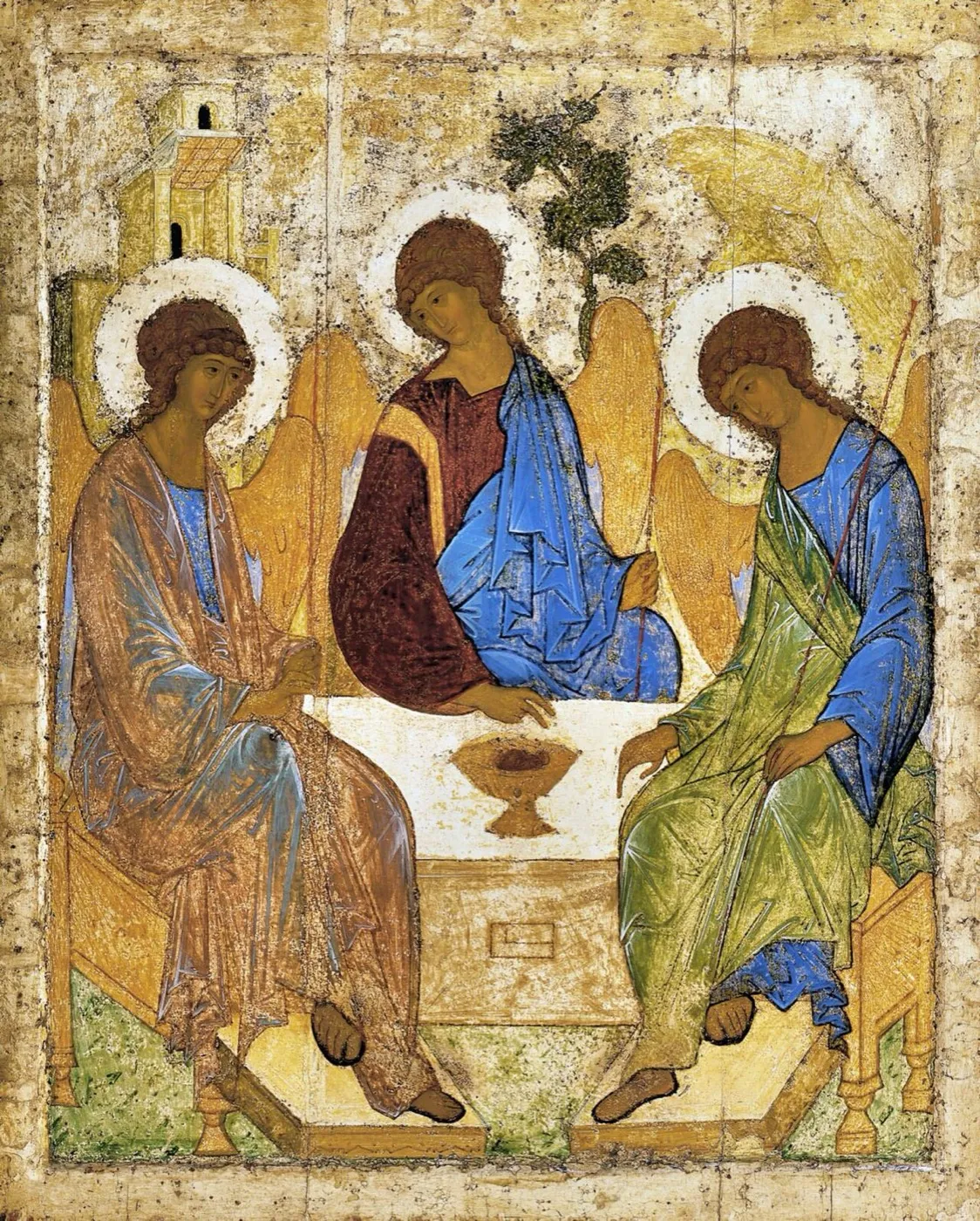
Andrei Rublev
This week the From Below will be screening Tarkovsky’s *Andrei Rublev * (1966) on Wednesday, November 26 at 7pm.
Here is the link to RSVP. Doors are at 6:50 and we’re starting the film at 7:10!
For 205 beautiful minutes, Andrei Tarkovsky shows the torments, wanderings, and witnessings of the titular Andrei, the 15th century Eastern Orthodox icon painter and saint, as he struggles with painter’s block. We’ve had our curatorial co-finger hovering over the big red Andrei Rublev button since starting the From Below, and we are thrilled to finally press play. The opening Prologue is one of my favorite sequences in any film I’ve ever seen. An opaque and beautiful treatise on the work of the artist and their relation to truth, Tarkovsky writes of the film, “Whether one wishes to fly before it has become possible, or cast a bell without having learned how to do it, or paint an icon – all these acts demand that, for the price of his creation, man should die, dissolve himself in his work, give himself entirely”
In Andrei Rublev we see the unity of supposed opposites: revelation, miracle, and the infinite found in the muddy reality of the finite. Quoting Thomas Mann, Tarkovsky concludes in his essay “Art–Yearning for the Ideal,” that the artist is not free: “The genius is revealed not in the absolute perfection of a work but in absolute fidelity to himself…Only indifference is free. What is distinctive is never free, it is stamped with its own seal, conditioned and chained.” We will be wondering about theories of fidelity, truth, freedom, license, and the miraculous down in our chilly little basement chapel this week. If you miss the screening, you may want to circle January 29th on your calendar; it’s Rublev’s feast day and would be the perfect moment to return to the film on your own.
I’m going to just let Tarkovsky take us away with some more of his Big Claims about the history of Art:
“Father Pavel Florensky…says that the inverted perspective in the works of the [medieval] period was not the result of Russian icon-painters being unaware of the optical laws which had been assimilated by the Italian Renaissance, after being developed in Italy. Florensky argues that it was not possible to observe nature without discovering perspective, that it was bound to be noticed. For the time being, however, it might not be needed–it could be ignored. So the Renaissance perspective expresses the need to throw light on certain spiritual problems which Russian painters, unlike their Italian counterparts, had taken upon themselves. (One account has it that Rublev had actually visited Venice, in which case he must have been aware of what Italian painters had been doing with perspective.) If we round off its date of birth, cinema can be said to be contemporary with the twentieth century. That is no accident. It means that rather over eighty years ago the point was reached when a new muse had to emerge. Cinema was the first art form to come into being as a result of technological invention [wild claim], in answer to a vital need. It was the instrument which humanity had to have in order to increase its mastery over the real world [even wilder claim]. For the domain of any art form is limited to one aspect of our spiritual and emotional discovery of surrounding reality. As he buys his ticket, it’s as if the cinema-goer were seeking to make up for the gaps in his own experience, throwing himself into a search for lost time. In other words he seeks to fill that spiritual vacuum which has formed as a result of the specific conditions of his modern existence: constant activity, curtailment of human contact, and the materialist bent of modern education.“
Conditioned and chained and seeking to fill that spiritual vacuum,
Stefan, Charlie, and Stark