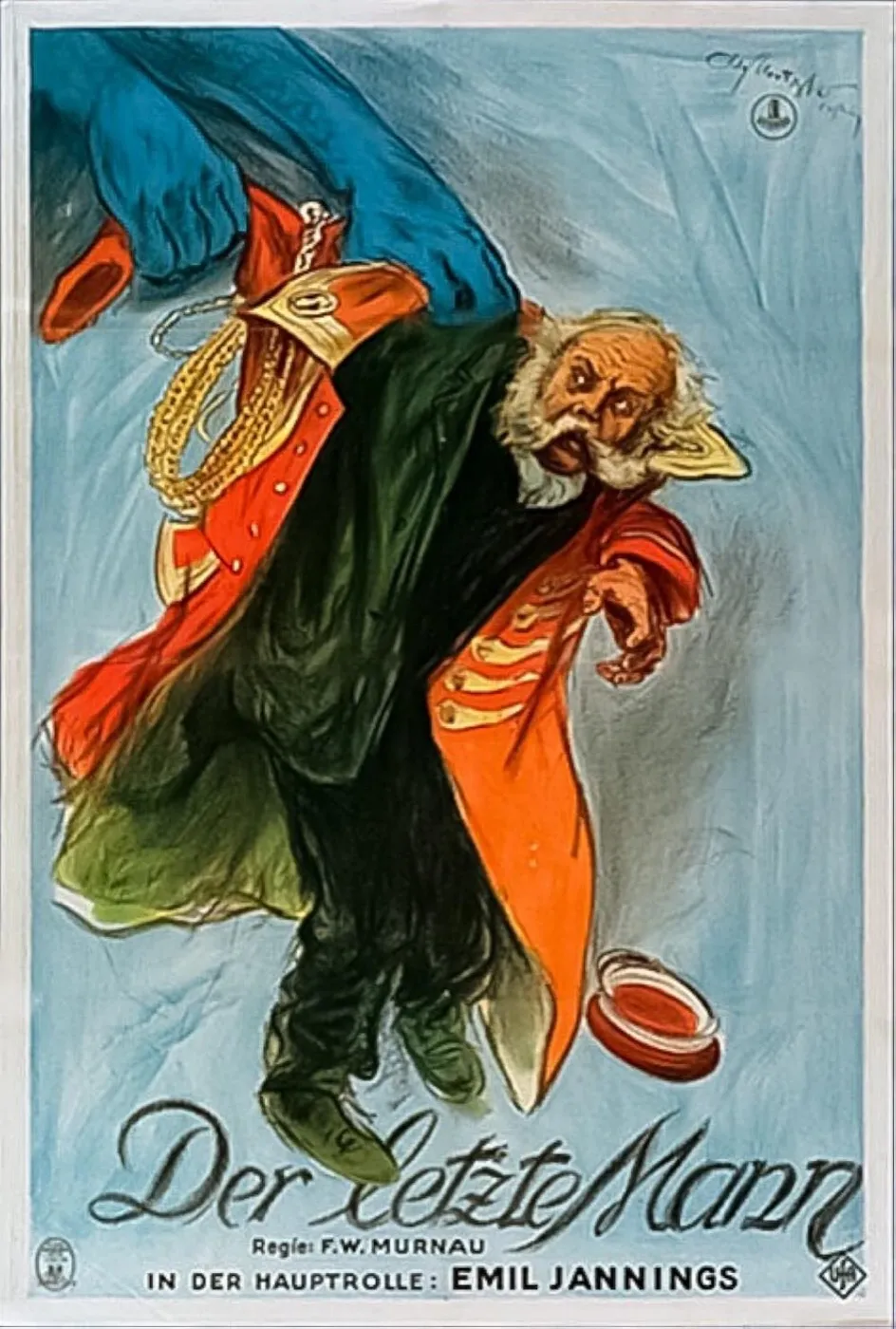
The Last Laugh
This week we’re presenting F.W. Murnau’s The Last Laugh (1924) on Thursday, November 13th, at 7 PM.
Here is the link to RSVP. Doors will be at 6:50 and we’ll start the show at 7:10!
After a run of weeks in the From Below that delve into concepts of cinematic space—starting with our shorts program on haunted spaces, followed by our Halloween surprise screening of Anguish which makes a meal out of turning the movie theatre itself into a space of horror, to the more mournful exploration of the movie theatre as a location embedded with longing and the ghosts of the past in Goodbye Dragon Inn—we now turn back the clock 101 years to a film that fundamentally changed the way that cinematic arts relates to the dimension of space.
F.W. Murnau’s The Last Laugh is a strange tale, striding the gulf between false dichotomies of tragedy and comedy, realism and expressionism. Emil Jannings stars, majestically, as a nameless doorman for a prestigious hotel who clings, quite literally, to the vestments of his position as the key to his social esteem and his self worth. He is, however, getting older and less physically able to perform the tasks assigned to his role. Relocated by his manager to be a washroom attendant, the doorman’s life (one notes he is given no name other than his title) unravels in shame both internal and amongst his community. What could be a comedic conceit, and certainly Jannings embodies his character with a sense of inflated pride almost begging to be punctured by a Chaplin-esque figure wandering through the scene, instead reveals the desolate sorrow of one’s life being quietly stripped of meaning. And yet, beneath that, many unsettling, absurd things are happening—Murnau notes himself that a core joke of the movie is that “everyone knows that a washroom attendant makes more than a doorman” (perhaps this has been a little lost to time), several signs throughout the movie are written in an imaginary language, and there’s also the tricky appearance of an authorial intervention in the narrative via a tone-shifting epilogue.
Murnau also said, in making this film, “All our efforts must be directed towards abstracting everything that isn’t the true domain of the cinema. Everything that is trivial and acquired from other sources, all the tricks, devices and cliches inherited from the stage and from books.” This is notably evidenced by the lack of inter-titles throughout the film, which silent films perhaps obviously made frequent use of in order to guide and structure the narrative being told. The Last Laugh hardly needs them, so beautifully and expressively is the tale told through the eye of the camera. And returning to the concept of space, the most notable technical innovation that The Last Laugh brings to the history of cinema is, for the first impactful time, the use of a moving camera unchained from the tripod. You can feel this in the first shot of the film, which descends into the hotel lobby in an elevator and sweeps across the vestibule, capturing the comings and goings of guests and employees in one encompassing shot. Almost akin to the “You Ain’t Heard Nothin’ Yet” in The Jazz Singer issuing in the era of sound in film, this one shot embeds the future within itself. In Samuel Frederick’s monograph on the film, he emphasizes the revolutionary possibility of a mobile camera—not only does it, along with the montage, coalesce a truly new art form of film that moves beyond the mise-en-scene of stagecraft, but it fundamentally alters the material of cinema from just ‘time’ to the relationship between time and space. By unchaining the camera and unlocking space as a dimension of exploration for film, Frederick declares, “[The Last Laugh] is the beginning of modern “The Last Laugh [is] the first full realization of the medium’s true potential,” Frederick declares, “one might even say the beginning of modern cinema as such.”
Silently, Charlie, Stefan, and Stark