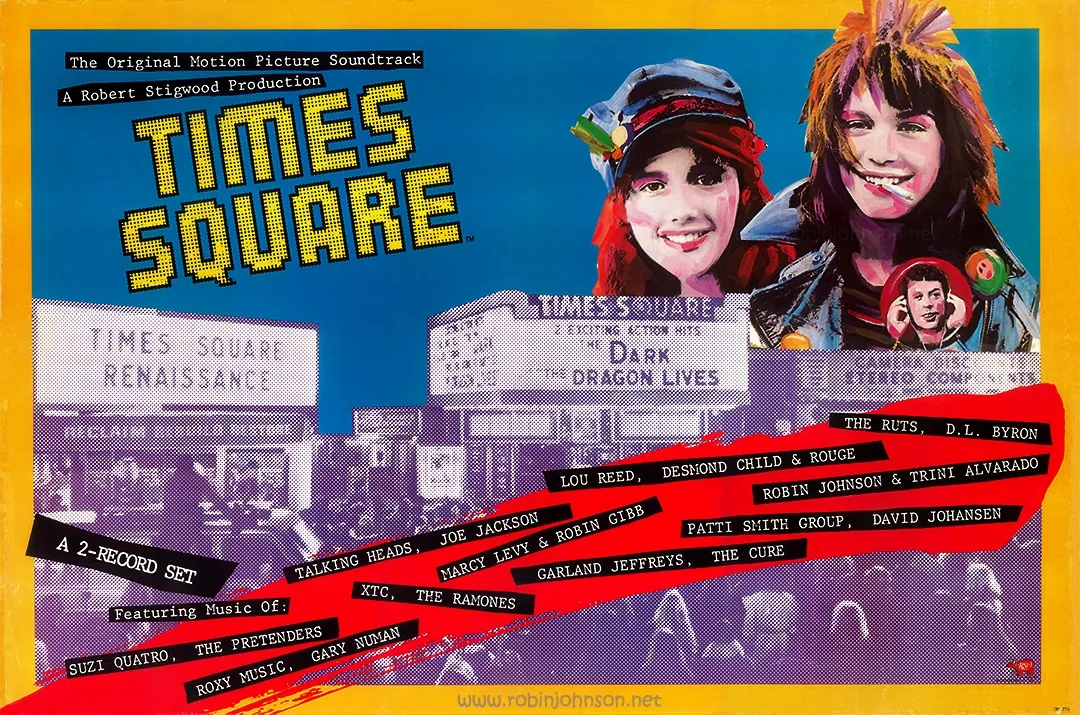
Times Square
This week we’re presenting Times Square (1980) on Thursday, July 31st at 8pm.
Here is the link to RSVP. Doors will be at 7:50 and we’re starting the film at 8:10!
*IMPORTANT PROGRAMMING NOTE: The week after this, we are considering doing a From Below Rerun of one of our popular/bespoke programming nights. We are debating a few options, and want your input! Let us know what you’d like to see! *
I was first introduced to the film Times Square in a lecture by the theorist Jack Halberstam titled An Aesthetics of Collapse. In this lecture, Halberstam examines the utopian possibilities found in ‘unworlding,’ an inversion of world-making that is generated through projects dealing with collapse and ruins. In this specific case, Halberstam looks at the decaying piers along the Hudson River, which became a site for gay cruising throughout the 1970s, captured beautifully in the photographs of Alvin Baltrop
and home to Gordon Matta-Clark’s anarchitecture installation-park Day’s End.
In the midst of this, Halberstam digresses to call Times Square “the greatest queer movie never seen.” Readers, with a claim like that I ran to find a copy of the film. Part of the unlikeliness of this claim is that Times Square is made by the production team behind Saturday Night Fever, and in some ways, it’s an attempt to repeat the success of that film through inverting it. Instead of John Travolta, paragon of wounded masculinity that he is, this film would focus on female subjects, and instead of disco, it would be soundtracked by punk. In both cases, the films provide New York tales that melds social realism amongst the Big Corroding Apple to a catchy soundtrack. Times Square was not nearly as successful (even being attacked by critics as being “evil” for presenting a NYC that is in any way safe for young girls to inhabit on their own) and was subsequently mostly forgotten, but what stands to be emphasized is that this was not some underground piece of outsider art, but instead a studio film meant for mainstream consumption.
What’s remarkable, then, is how much the movie is an incredible piece of queer world-making in and of itself, as well as being a profound filmic document of a specific moment in the history of New York. In the film, Trini Alvarado and Robin Johnson (two virtual unknowns at the time) star as teenage runaways from a mental health ward. Trini is Pammy, the all-but-ignored daughter of a city politician tasked by the mayor to “clean up” New York (natch), and Robin is Nicky, the much tougher street kid who dreams of being a star. Hiding out from the authorities, they take refuge in the red-light clubs of Times Square and the aforementioned piers crumbling into the Hudson, where they find support and self-recognition amongst the communities of dispossessed, with a little svengali-esque support from Tim Curry as radio DJ Johnny LaGuardia, who encourages them to form a punk band called The Sleez Sisters. Times Square is one of the only movies to capture these piers, these loci of queer activity, on film, and to have the characters build their makeshift hideout apartment here scaffolds the film, silently or not, on a history of queer utopias. Halberstam describes the film as an act of “making home in the ruined, collapsing structures,” not just the architectural structures of the piers but the societal structures that have cast away the nonconformists.
Walking on the Wild Side,
Charlie, Stefan, Stark