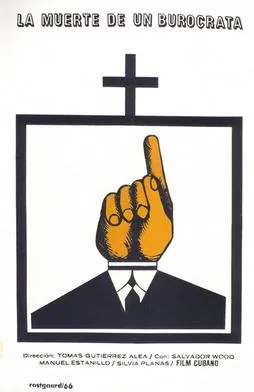
Death of a Bureaucrat
This week the From Below presents the first of an intermittent series on revolutionary Cuban cinema. We’ll be screening Death of a Bureaucrat (1966) paired with the documentary short film “Por Primera Vez” (1967) on Thursday, July 17, at 8pm.
Here is the link to RSVP! Doors will be at 7:50 and we’re starting the film at 8:10.
In our feature comedy, a dedicated communist killed on the job in a statue factory by a machine of his own invention is buried honorably with his trade union membership card by his comrades. To claim the pension owed to his widow, his nephew must navigate a bureaucratic labyrinth to exhume (and re-bury) the corpse in order to retrieve the precious union card.
Tomás Gutiérrez Alea is probably best known for Memories of Underdevelopment (1968) and Strawberry and Chocolate (1993). Considered the father of Cuban cinema and the island’s greatest auteur, he was a mentor to an entire generation of post-revolution filmmakers and a force for decades promoting the creation and distribution of films in Cuba. Death of a Bureaucrat is a hilarious satirical glance at, predictably, bureaucracy; a loving chide from a pro-revolutionary modernist standpoint. In the film the essentially human act of burial is over-mediated by an impersonal office, and the rigid adherence to the letter of procedure at the expense of sensible solutions to the problems of real life gets played well for laughs. Alea is oft quoted describing himself as a “man who makes criticism inside the revolution, who wants to ameliorate the process, to perfect it, but not to destroy it.”. Nimble and never stuck on one note, the film hits on a criticism of misogyny and is a snarky rebuke to didactic, stodgy socialist realism, choosing to approach its subject with surrealist dreaminess and absurdist slapstick whimsy, poking jokes along the way at communist self-memorialization (the deceased uncle worked in an absurd Jose Martí marble bust factory).
With his movie, Alea asks what is the role of art in the development of a revolutionary culture, and relatedly, what is the texture of the everyday, fifteen years after ecstatic revolutionary victory, now tasked with the banalities of administration of life and death? By my read, Alea himself is ambivalent and measured. The answer may be that life is kind of tedious, kind of parochial; in short, imperfect and small. The world historical process of Revolution is brought back down to earth humbly by the inescapability in life from death and laughter, not to be jeered at in the mud, but perhaps adored in its finitude and frailty.
Our short 10 minute companion piece, “Por Primera Vez” (1967), documents a single film screening of Charlie Chaplin’s Modern Times in a rural Cuban town by a revolutionary art initiative from the ICAIC
called the “cines moviles.” These state-backed artists outfitted trucks, motorboats, and donkeys with 16mm reels, projectors, and screens and travelled throughout the countryside hosting screenings for rural Cubans, many of whom had never seen a film before. Between 1961 and 1976 they screened to over 3 million people a mixture of Cuban-made films, documentaries, news reels, and cinema classics like Death of a Cyclist, Umberto D., Citizen Kane, and of course, lots and lots of Charlie Chaplin. This short and the history of the mobile cinemas demonstrates the significant place film had in Cuba as a part of the ongoing revolutionizing of everyday life, a theme we will continue to explore in the coming weeks!
Take a number, Stefan, Charlie, and Stark