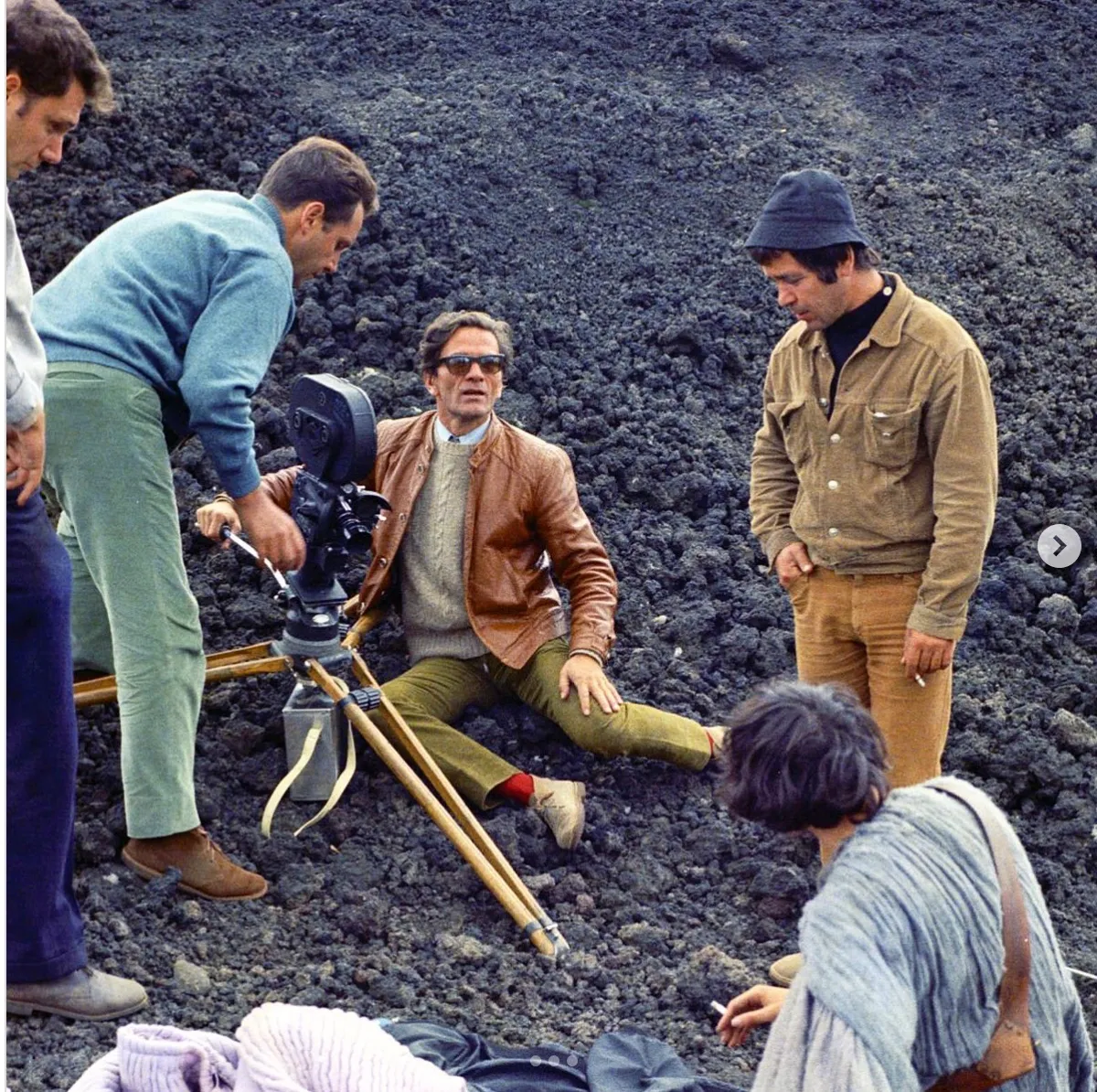
Porcile/Pigsty
This week the From Below presents Pier Paolo Pasolini’s Porcile (Pigsty) ( 1969) on Thursday, June 5th at 8pm.
Here is the link to RSVP. Doors will be at 7:50 and we’re starting the film at 8:10!
In an interview Pasolini once curiously named his first memory of cinema as the moment when, as a boy, he came upon a brochure that featured the image of an explorer being devoured by a tiger. The image struck him with what he described as erotic force, and serves as a kind of misty ur-text that repeatedly appears across the films of Pasolini’s prolific career, distilled in his claim, “The main fear and the greatest desire of the individual is to be consumed.”
I’m particularly excited to share this pick with all of you. For the last few months I’ve developed a little devotional routine of watching a Pasolini film every Sunday (a behavior that has caused some concern among friends, but I wish to assure you once again I’m alright). Among the many I’ve watched I’ve chosen this one, Pigsty, for its density, its beauty, and its distilled showcase of the many things I’ve grown to love about Pasolini’s films: desolation, the traversing of narrow ridges, beautiful textiles, outrageous headwear, anti-fascism, and his peculiar relationship to eating.
Pasolini’s work has been described as “voracious cinema.” Hunger was his muse, the metaphor by which he lived, the ground of his radical politics. Pasolini was known to revel in calling his camera a “reality-eater” and an “eye-mouth,” gobbling up and digesting the light and world, thinking of it as the first orifice that opens onto a digestive tract for chewing reality into a newly incorporated film. He made work in which restless characters hungrily seek or feed their unappeasable appetites as ravenous and cruel consumers. They eat, have sex, acquire treasure or power. Eating and not eating, having and not having, desiring and hating, always voraciously. By staying close to individual psychological experience of desire and the mouths of his characters, Pasolini sought to criticize and defamiliarize capitalism and fascism, attentive to the way people are consumed by factories and camps, tradition and time is digested into pulp by modernity, matter pulverized by industry, and the wildness of desire irrigated into roles for the reproduction of consumer society. Pasolini’s work saw the ways that appetite creates this world and attaches us to it, and, at the same time, could perhaps be followed to find a way out. In Pasolini’s films, in what I’m calling perhaps a cinema of indigestion, eating is made strange, and, tangled in the food web, we are invited to think about what, or who, we eat, and what, or who, eats us.
Porcile is composed of the resonances and dissonances between two stories woven together. In one, filmed on the craggy slopes of Mt. Etna, Pasolini places us somewhere out of place and out of time as we follow a hungry man (Pierre Clementi, the new object of my fascination) wandering the expanse, eating anything–and anyone–he comes upon. This portion of the film is non-verbal (perhaps pre-linguistic?), mythic, desolate. The second story is a kind of Bartleby tale, where Julian, a rich heir, played by darling of the French New Wave Jean-Pierre Léaud, mopes around his father’s palace in 1968 Germany, equally disinterested in his family’s bourgeois activity and the proddings by his militant activist girlfriend for him to join her in the student movement in decisive revolutionary action out on the barricades. Julian, however, seems most driven to spend repetitive days alone with the pigs in the neighbor’s pigsty. All the while Julian’s father eagerly awaits a meeting with a resurfaced Nazi collaborator, a rival industrialist, freshly recovered from a facial reconstruction surgery to avoid accountability for his wartime allegiances.
Porcile is gorgeously photographed and is a dense, dense text worthy of a careful chew. A cinema of indigestion suspends consumption, thwarting and confoundng slick interpretation. It’s a tough pill to swallow. Rather than giving heroes to identify with, we are disoriented, left with inconsistent intensities of feeling and no exemplars to guide our action. His cinema is not, however, a hostile refusal of all signification. Instead it’s a flirting invitation for the audience to read the work, to dare to interpret. Pasolini’s work is to be tasted, and its puckering flavors to be felt on the lips. Porcile sits at a creative pivot point between Teorema and his later beautifully costumed, bawdy desert-filmed anachronisms, such as Medea, Oedipus Rex, and his Trilogy of Life, showcasing a new turn after leaving his early neorealist style further and further behind. Porcile is often described as a kind of companion to the last film Pasolini made before he was murdered, Salo, or 120 Days of Sodom, which so happens to be showing on 35 mm at the Hollywood Theater
next week.
Consumptively,
Charlie, Stefan, Stark
Pasolini on the set of Porcile