The Cruise
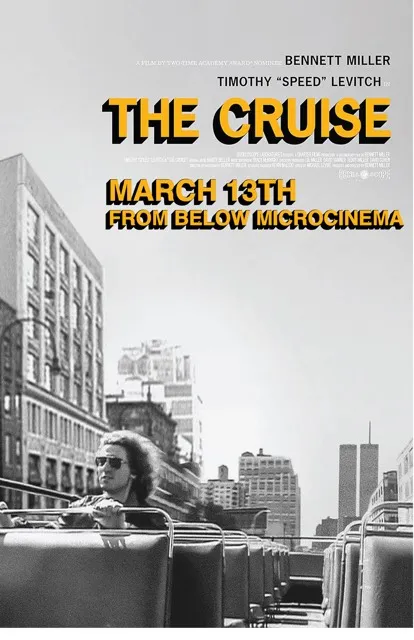
On Thursday we’ll be showing part two of our pairing of films on Being Alone while Charlie’s off toiling away in Washington in focused solitude. Contrasting sharply to last week’s nearly dialogue-less, lushly colorful exploration of haunted life on a British isle, we’re going to watch The Cruise (1998), a black-and-white, shot-from-the-hip monologuing roam through city and speech.
Here is the link to RSVP. Doors will open at 6:50 and we’re starting the movie at 7:10!
In The Cruise we are borne bus-back and by foot through late 90’s New York City to the nasally ramblings of Timothy Speed Levitch, a clown poet of a Gray Line tour guide.
Our twerpy Virgil leads us through a New York hell he loves, weaving together an idiosyncratic history of art, architecture, and celebrity together with his own theories of desire, perception, space, time, and freedom, bending the genre of a tour into a feast of speech. Speed Levitch is absolutely a partisan of the wiggly world, fighting for the wiggle room necessary for freedom within and against the anti-life forces that narrow, numb, and restrict. The genre of documentary film and Levitch’s words overlap.They are arts of noticing and relishing, and this film explores how the practice of those arts may become a way of life.
Like its fraternal twin Enys Men, The Cruise is another rare instance in which we have the director actually holding the camera. This is Bennet Miller’s first directorial project, long before he found fame helming Hollywood Oscar-winner biopics Capote (2005), Moneyball (2011), and Foxcatcher (2014). Filmed crewlessly, this is the work of just Miller in natural New York street light holding his Sony DCR-VX1000 camcorder,
equally popular among skaters and pornographers, up to his subject’s face. He produces a sincere handmade artifact of simple gumption, marrying the outsider spontaneity of the content of Levitch’s rambling to the actual form the film’s making took.
Speed Levitch himself feels to me like the end of something, beautifully rusty remains shriveled on a vine watered by decades of Greenwich Village runoff. Neither is he one of the Great Artists of New York he idolizes, nor a mere member of the tourist-commuter herd, Levitch is a megaphone-toting Hermes straddling the world between the spectators and doers, artists and lookers. An inheritor of a Neo-Situationist, Post-Beatnik, Baudelairean sensibility, Levitch shows up on camera at the pre-9/11 tail-end of Giuliani’s tough-on-crime New York gentrification. No Wave has been dead for decades, Warhol’s Factory has quieted, and the clamor of the squatter movements of the Lower Eastside has lulled. The last moments of the second millennium are draining out, and he’s telling us all about it. This is an excellent, small entry in the cinema of place and a sterling exemplar of my new pet genre: Guys With a Microphone.
Against the anti-cruise, Stefan, Charlie, and Stark