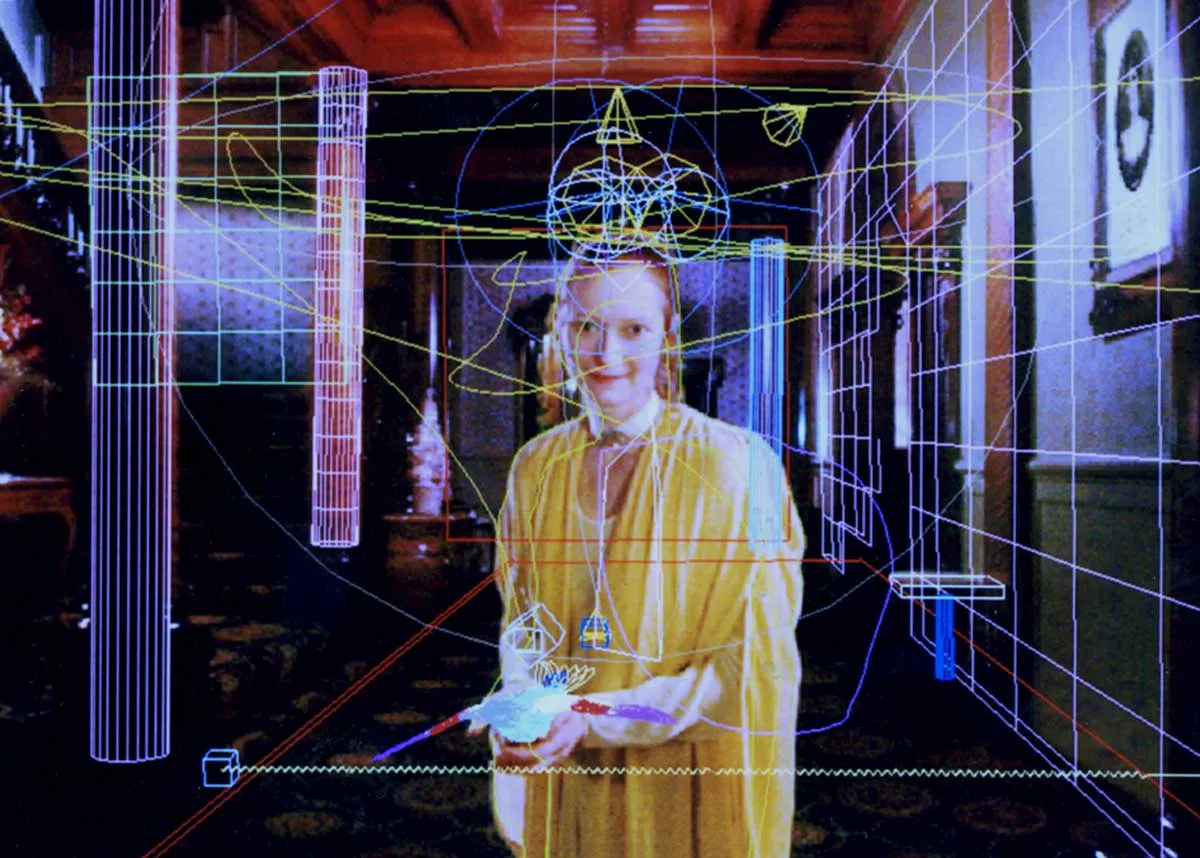
CONCEIVING ADA
The From Below launches ADVANCED TILDA STUDIES with Conceiving Ada (1997) on Thursday, January 30th, at 7 PM!
Here is the link to reserve a seat. Doors will be at 6:50 and we’re starting the movie at 7:10!
This week, we are launching a new series for 2025 that we hope to be returning to on a semi-monthly basis: ADVANCED TILDA STUDIES. As any good patron of the cinematic arts, we here at the From Below love the work of one Ms. Tilda Swinton, the otherworldly presence whose career started as the muse to Derek Jarman before becoming a mainstay of both the indie art house of your Wes Andersons, Jarmuschs, Guadagnino, and Bong Joon Hos, as well as the multiplex world of your Narnias and Doctor Stranges. That being said, we took notice that there was a little bit of an unexplored side of Swinton’s career: between those eras, there’s a little decade known as the 1990s that seems to have a bushel of Swinton vehicles that seem beguiling and bizarre and fairly undersung. In order to remedy that, we are exploring some lesser-known Swinton films in ADVANCED TILDA STUDIES.
To kick things off, we are delving into the Sea of Swinton with 1997’s Conceiving Ada, directed by Lynn Hershman-Leeson. You may know their second collaboration, Teknolust, but for our money Conceiving Ada is an even more interesting movie, exploring themes of utopian cyberfeminism on the verge of a newly connected millennium that play much differently in 2025 than they did in 1997.
In the film, Francesca Faridany stars as Emmy Coer, a very, very 90s computer genius who invents a program that taps into ‘information waves’ in order to communicate with the past. In doing so, she develops a cybernetic relationship with Ada Lovelace (Tilda Swinton), the 19th century savant who developed the concepts of computational language but was constrained by the gender expectations of her time.
What plays, in the world of the film, as a largely hopeful belief in the power of technology as a liberatory tool, plays a bit differently in our era of AI predominance, making this movie a fascinating object to think about and discuss. Beyond that, it’s a delight of a film, with plenty of Y2K-style computer graphics, Tilda delivering a masterful and heart-rending performance as computerized Ada Lovelace, and an aesthetic vibe that I would describe as “Wishbone, but sexier?” Come for Tilda, stay for Timothy Leary cameos, Karen Black, a truly bizarre digital dog, and much more.